
Science as Collective Sensemaking

What is Science?
The question of “what is Science”, while philosophical in nature, is an important starting place if we are to understand the impacts of AI for Science.
Today, many AI for Science startups presume simplistic models of what Science is and how it works e.g. Science as producing papers, Science as producing data.
But both of these models mistake the artifacts for the actual substance. Ask any scientist about a paper in their field and they’ll tell you about everything it left out or glossed over, including sometimes in their own paper. And while foundation models like AlphaFold are useful, and data is often a bottleneck to developing such models, the process by which those AI models create scientific value is still evolving.
Ultimately, a poor model of Science will lead to a poor company.
Science as Collective Sensemaking
My preferred model is Science as Collective Sensemaking.
Science is the process by which a select set of people whom we call scientists come to an agreed upon understanding of our perceived reality. As Polanyi describes in his essay Republic of Science, scientists are a body politic which determines how to allocate limited intellectual and material resources through “mutual adjustment” based on peer feedback and results.
The locus of Science is not in papers or data. These are merely the outputs of the sensemaking process, often playing an ancillary role.
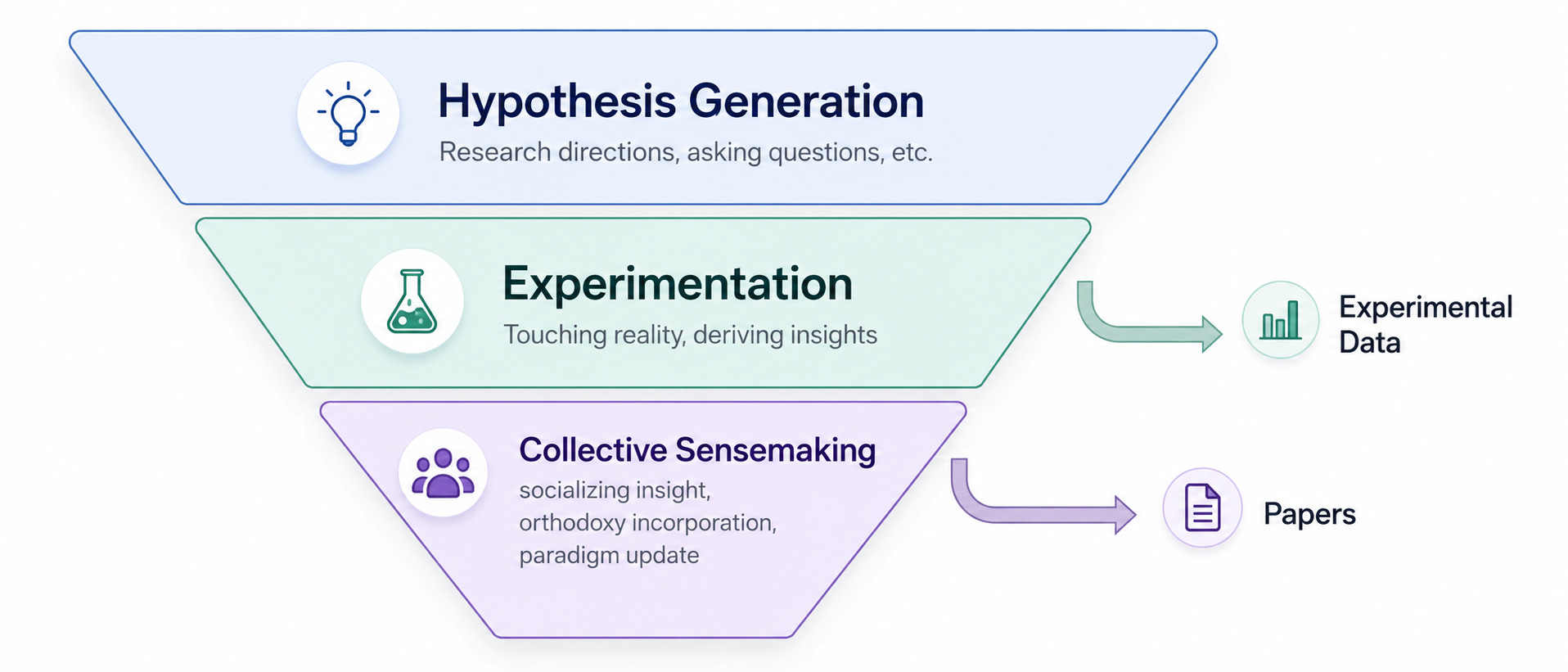
Instead, the production function of Science is manifested in its purest form at the department seminar and the science conference. It is in those rooms that initial evidence is shared, feedback is gathered, the scientific collective updates its priors, and new research directions are identified.
It is worth noting how remarkable this system is. The invisible hand of the market is the best mechanism we have for discovering the value of something. The modern republic of Science, which is not without its flaws today, allows communities of scientists to collectively assess the value and validity of ideas without prices. The general failure of philanthropy and non-profits should serve as a useful benchmark for just how difficult it is to assess value creation in non-market conditions. It is a miracle that Science has worked as well as it has, for as long as it has.
But, with this view of Science as Collective Sensemaking, where does this leave AI?
AI & Scientific Sensemaking
At the object level, there are several different ways AI will impact Science:
Across every scientific field, LLMs will marginally increase insights from literature and hypothesis generation
For any field or scientist that uses code, AI coding agents will be an accelerant
Foundation models will serve as useful instruments but the value they provide and the barriers they face will vary by field
I am tremendously optimistic about the impact AI will have as a new tool for scientists, in all these different ways. But at the system level of Science, the effects of AI are still unclear.1
The role of scientific publishing, which I argue is an ancillary output of the production of Science, will only become more marginalized as the peer-review publication system comes under increasing strain with a flood of AI-generated papers. As a result, collective sensemaking as a social technology will become more important when scientists have even less reason to trust scientific publications.
Ultimately Science is a human endeavor. The truths of the universe are undoubtedly out there. They may even be inside the model weights of GPT-6.1. But if no one finds them, understands them, agrees with them, and builds on top of them, does it matter? Mendel discovered how traits are inherited, but did it matter if no one knew about his discovery?
So too for AI in Science. The models may ask better questions and make more discoveries, but it only “becomes” science when those discoveries and insights are incorporated into our collective understanding.
The true bottom of funnel for the scientific process is not the published paper but the moment the core insight is baked into the invisible body of scientific orthodoxy.
This socially mediated process may be the ultimate binding constraint on the magnitude of the impact of AI for Science. It may be that the AI productivity gains in Science are rate-limited by the pace at which the scientific collective can update from new discoveries and findings, and are ultimately mild compared to AI productivity gains in other parts of the economy.
That the science sensemaking process is still most concentrated in academic conferences and ivory tower department seminars is a sign of how little it has benefited from digital publishing or other software tools for collective intelligence. The story of Mendeley is a canonical example of how at odds science publishers’ incentives are with building better tools for collective sensemaking. Acquired by the publishing giant Elsevier in 2013, it had its social features quietly retired by 2021 reducing it back to a mere reference manager. Science Twitter was a genuinely active scene at one point, but much of it has since disappeared or dispersed onto LinkedIn and Bluesky. Neither platform was built for collective sensemaking among scientists, and both serve as poor, crowded substitutes.
The truly visionary AI for Science company is not automating experiments or AI-generating Nature papers, but building technology to improve the collective sensemaking ability of scientists.23
See this recent Coefficient Giving Abundance & Growth blog for a useful first-order model of how the jagged frontier may present in AI productivity gains across different scientific fields.
The go-to-market challenge is that Science is not a monolith but rather a vast field of different sub-fields and communities of practice. Winning market share in one is almost independent of adoption in another field.
"The models may ask better questions and make more discoveries, but it only “becomes” science when those discoveries and insights are incorporated into our collective understanding."
In a way, it also requires that multiple people care. If I find something new, but only I care about its implications, it will likely not become science anymore than if it is in the weights of GPT-6.1